
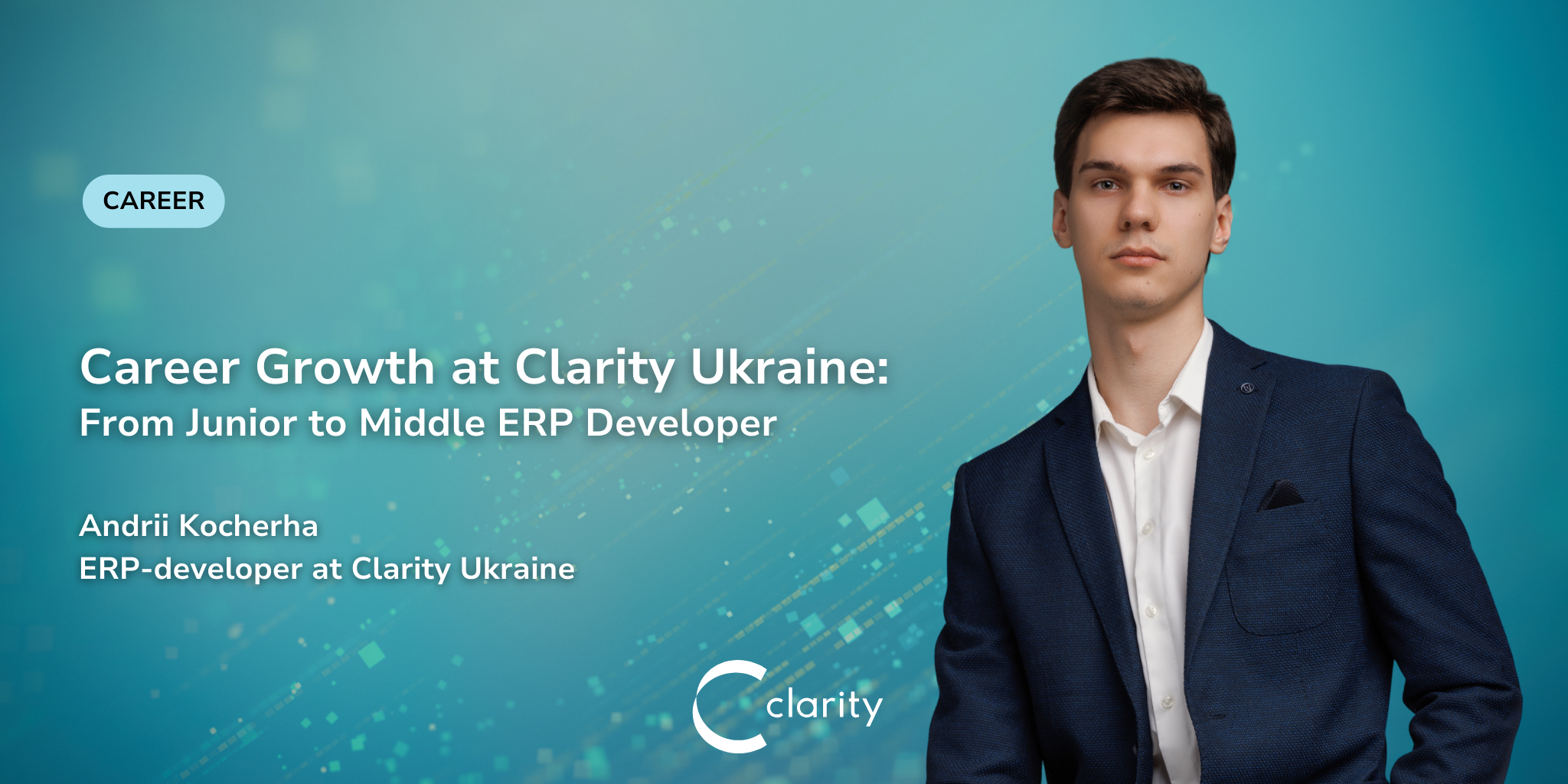
Interview with Andrii Kocherha
In this career interview, we speak with Andrii about his journey from Junior to Middle ERP Developer at Clarity Ukraine. This conversation is especially valuable for students, graduates, and young professionals who want to start a career in ERP development, IT consulting, and business software implementation but are unsure how to grow and build the right skills.
How did you get into ERP development?
Tell us about your education and how you found the vacancy.
I studied Computer Engineering at KPI. At the end of my third year, I felt that I had gained solid foundational programming skills and wanted to try myself in a real job to better understand my professional direction.
At that time, one of my classmates was already working as an ERP developer. He described it simply as developing systems that help businesses operate more effectively. When a friend suggested I attend an interview at Clarity Ukraine for an ERP Developer position, I decided to give it a try. I wanted to better understand what ERP systems are, how businesses operate internally, and how software development can support business processes.
What expectations did you have when joining Clarity Ukraine?
Initially, I was simply curious about the ERP field. I wanted to understand how everything works, what my role would be, and which tools and technologies I would use. After the first stages of the interview, when I learned more about the company’s core activities, programming language, and development approach, I became eager to join the team and start working on real ERP projects.
What surprised you most during your first months as a Junior ERP Developer?
The most surprising aspect was the number and uniqueness of business processes that need to be covered in ERP implementation. It was fascinating to see how a client request like “We need this document to transform into specific entities when a button is clicked” turns into a structured specification and later into a fully implemented feature.
The programming language we use also has its own specifics. I started learning it from scratch, and even now I continue discovering new patterns and implementation approaches.
How did your adaptation to the team go?
The adaptation process was smooth. It felt like I had been part of the team for a long time. I could approach anyone with a question and receive either a clear answer or guidance on who could help.
Developers supported me with technical advice and shared practical insights. Consultants explained complex business logic and helped with testing. Management was always open to discussion. I could bring questions, ideas, or concerns and feel heard.
Who or what helped you most at the beginning of your ERP career?
People played the biggest role.
Dmytro was my mentor. We had in-depth discussions about the material, and he supported me during my first development tasks. I still approach him with interesting technical cases.
Oleksii, our Dev Lead, introduced me to internal development processes and helped me set up the environment. He was always available for questions.
Anastasiia was one of the first to review my pull requests and helped me adapt to both the new programming language and the team’s coding standards.
What was your first small professional success?
The first task that was accepted, tested, and included in the release version. Seeing your code in production is a strong motivational boost for any Junior ERP Developer.
When did you feel you were transitioning to the Middle ERP Developer level?
I can highlight three main indicators.
First, the tasks became more complex. They required architectural thinking and understanding how changes would affect existing ERP functionality and future development.
Second, communication and responsibility increased. I started participating in direct client meetings where I had to gather requirements and propose implementation options.
Third, the area of responsibility expanded. I realized that sometimes it is better to reassess a decision, acknowledge underestimated complexity, and propose a better solution instead of continuing in the wrong direction.
How did your mindset change from Junior to Middle?
You begin to look at the project as a complete solution rather than focusing only on your specific task. You consider how your implementation will affect previous developments and whether it will simplify or complicate future changes.
With experience, you learn which details require deeper attention and which seemingly small elements may cause significant issues later in large ERP systems.
Which personal qualities helped you grow in IT consulting and ERP development?
Curiosity. When I see something new, I try to explore and understand it. Later, this knowledge often becomes useful in real business cases.
Do you consider Microsoft certification an important milestone for a specific grade?
The certificate itself is less important than the preparation process. Studying for certification helps structure your knowledge, deepen your understanding of ERP technologies, and discover new aspects of the platform.
What would you advise those who want to grow faster in their ERP career?
Do not be afraid to try new technologies or directions within ERP systems. Take initiative, explore new tools, and propose improvements for daily tasks. Initiative and responsibility significantly accelerate professional growth.
Which project highlighted areas for improvement, and where did you feel professionally confident?
The Dila project showed me how much more there is to learn. It has a large custom codebase and non-standard implementation approaches. Working on a live project with frequent releases helped me understand production-level ERP development better.
On the FCA project, I communicated directly with the client, discussed implementation details, and independently made architectural decisions. There I felt confident in my expertise as a Middle ERP Developer.
How would you describe the culture at Clarity Ukraine?
For me, it is a culture built on mutual respect, support, and open communication. You can share a problem and be sure that you will be heard.
How does the team influence your professional development?
The team accelerates learning. Instead of spending hours researching alone, you can receive structured explanations from experienced colleagues. At the same time, this motivates you to study independently and share new approaches with others.
What does colleague support mean to you?
The ability to ask for help, be heard, and receive both professional guidance and emotional support.
Do you feel trust from management?
Yes. Management is approachable and open. If a challenge arises, it is easier to discuss it openly and find a solution together rather than handling it alone.
How do you maintain your mental health and work life balance?
In my free time, I play games, do sports, and meet friends.
After intensive periods, switching activities helps the most. Physical activity is a good counterbalance to coding. Sometimes the best recovery method is simply allowing yourself to rest without overthinking.
A healthy work life balance means having enough time for work, daily responsibilities, hobbies, and rest.
How do you see the future of ERP development? Will AI impact the profession?
Artificial intelligence can become a helpful assistant for automating routine tasks, generating basic structures, and searching for information. However, due to the complexity of ERP systems and their deep connection to business processes, AI is unlikely to fully replace ERP developers in IT consulting.
What opportunities at Clarity Ukraine do you value the most?
The opportunity to continuously develop professional skills on real ERP implementation projects. Interesting clients, challenging requirements, and a supportive team create strong conditions for career growth in IT consulting.
What are your goals for the coming years?
New projects and new experience. Continuous professional development in ERP systems and business software solutions.
Who would you recommend to join Clarity Ukraine?
Anyone who wants to work at the intersection of business and software development, is ready to learn continuously, and wants to build meaningful solutions for real companies.
This interview provides practical insights into how to start a career in ERP development, grow from Junior to Middle level, and build a sustainable path in IT consulting.